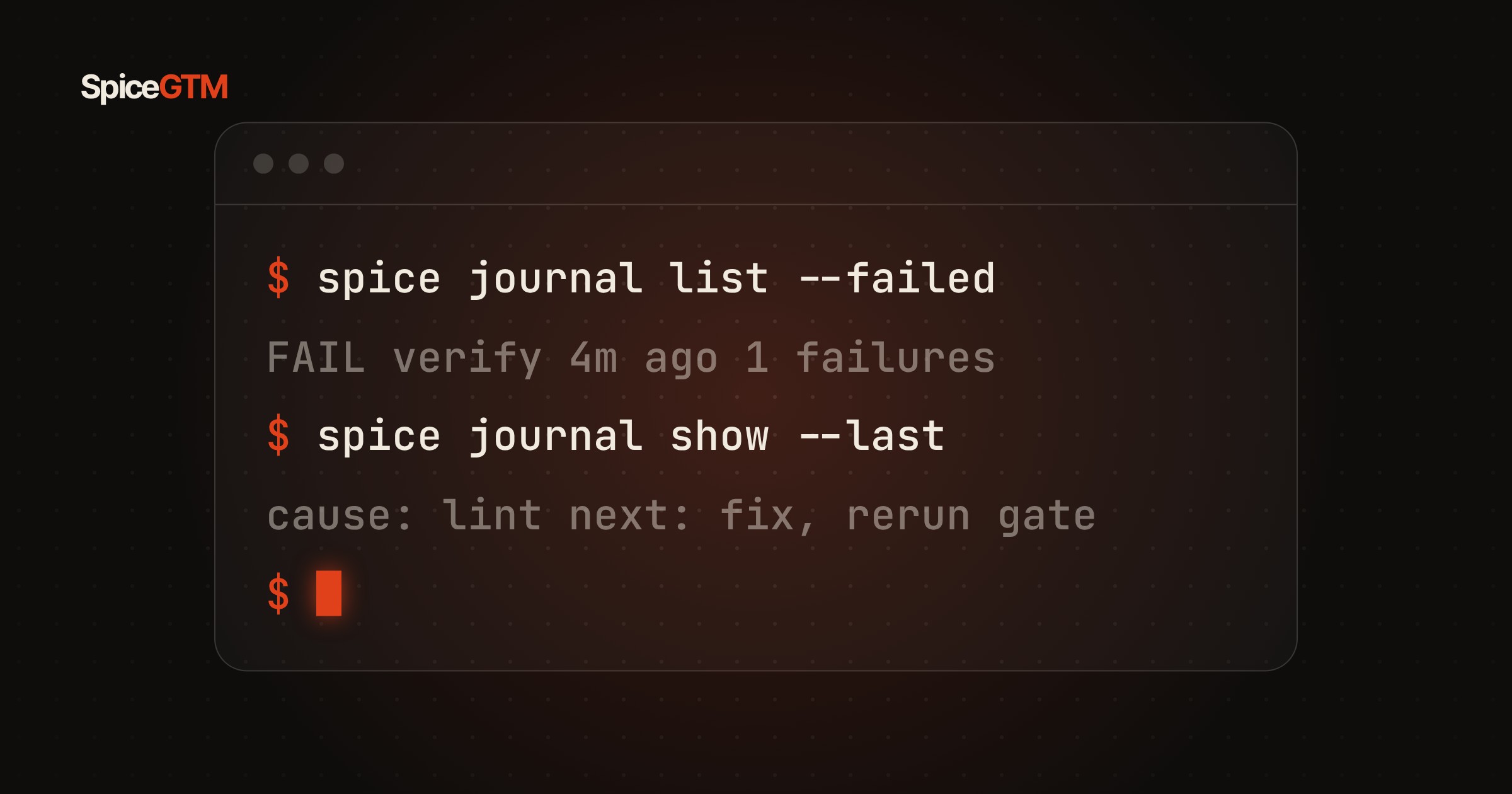
The biggest skill file in our Engine repository weighs 59,268 bytes. When a command finishes, its run comes back as one line, 101 to 113 bytes in our journal. Load the skill and the model drags about 15,000 tokens of instructions into every call that follows. Read the line and it carries about 30.
That gap shaped how Spice GTM is built. We started with skills and still write them. The work that has to run every night, the same way for every client, goes through a command line.
What a skill does well
A skill is a text file the model reads before it starts. Nothing teaches an agent a new procedure faster: write down the steps, name the tools, run it. Our Engine has 29 live skills, and the median one is 14,794 bytes, about 3,700 tokens before the model has done a thing.
Problems start on the second run. The skill says what to do, and the model works out how to do it from scratch each time. Monday's calls come out a little different from Friday's. When something fails, the error sits in one chat transcript and is gone when the chat closes.
What the command takes over
The Engine is a single TypeScript core, and the operator reaches it through one command, spice. Its help lists 283 subcommands in groups: signals, market, audience, play, sending, launch, account, crm, client, journal and admin.
Each subcommand states what it changes, whether it costs money, which flags it takes and what to run after it. The ones that spend money carry a $ in the help, so the risk is visible before anyone presses enter.
spice journal list --days 7 --failed
FAIL 2026-11-23T15-41-37Z-39d3fe  verify               4m ago  159644ms  0 calls, 0 gaps, 1 failures
That one row, 101 bytes, is what the model sees. If the run matters, it opens it with spice journal show --run <id>. It never loads the full help either, which is 52,415 bytes. It asks about one subcommand at a time, and the help for journal list is 1,085 bytes.
The model calls a command and reads a verdict. The raw output stays on the machine that ran it.
Where the tokens go
A model rereads its whole context on every call, so whatever sits in the context gets paid for again and again. We looked at our own spend for the 14 days to 12 October: of $11,200, 41% went to subagents that each carried around 150,000 tokens.
Then we measured the skills. All 29 together come to 584,388 bytes. At roughly four bytes per token, that is about 146,000 tokens, the same size as the contexts behind that 41%. The largest skill is about 520 times the size of the one-line verdict. Four bytes per token is a rule of thumb, so trust the ratios more than the exact counts.
The savings come from what never reaches the model. A command that pulls a list, enriches it and checks it can produce thousands of lines. The Engine writes them to its journal and prints a count, a status and the next step, which is all the model needs to decide.
A command can be tested
You can't run a test against a paragraph of instructions. You can against a command. Every change to the Engine passes a gate, and one of its checks pulls each command line out of the skills and confirms it still runs. The latest gate in the journal reports "207 command line(s) in the skills, all runnable". If a skill and the code drift apart, the gate goes red.
Keys work the same way. The agent never holds a credential. The Engine sits behind a small service that keeps every key, and the agent asks it for an action. The service performs it with a key the agent can't read.
The journal remembers
Every Engine command opens a run. Each outbound call gets recorded, and so does each printed result, all in one place. Nobody has to switch logging on. Our debugging skill is blunt about it: don't diagnose from memory and don't rerun to see what happens, because a rerun hits the providers on a different day.
The journal is big enough to answer real questions. The last 6,000 runs, from 19 to 23 November, contain 192,959 calls. Gate history lives there too. Every gate run is a row with a cause, 4,220 of them in the last 90 days, and one command reads them all.
spice journal list --command gate --days 90 --limit 6000Once a failure is in the journal, you can count it, sort it and fix where it starts. When a failure only gets mentioned in chat, someone finds it again next week.
When to stop writing skills
Start with a skill. It takes an afternoon and shows whether the procedure is worth keeping. Move the steps into a command once the same steps run for a third client, or the output gets long, or a step can spend money or reach a real person. Keep the skill, and cut it down to which command to call and when.
The model then does what it's good at, choosing the next step. The command does what models are bad at, doing the same thing the same way every time.
If your GTM work lives in prompts and you'd like it to run like this, book a call at spicegtm.com.